

How to Use Prompts Effectively with Autistic Individuals
Prompts can be used by anyone who is teaching or showing another person a new skill or task. They are additional cues which are delivered following an instruction, designed to help a person learn what the appropriate response is in a certain situation. Prompts are teaching tools that support efficient learning and lower frustration. They also support errorless learning by making sure that the person is able to respond correctly, making it more likely that the person will use the skill again.
Prompting is used not used alone but alongside other strategies such as modeling, visual supports, or social narratives.
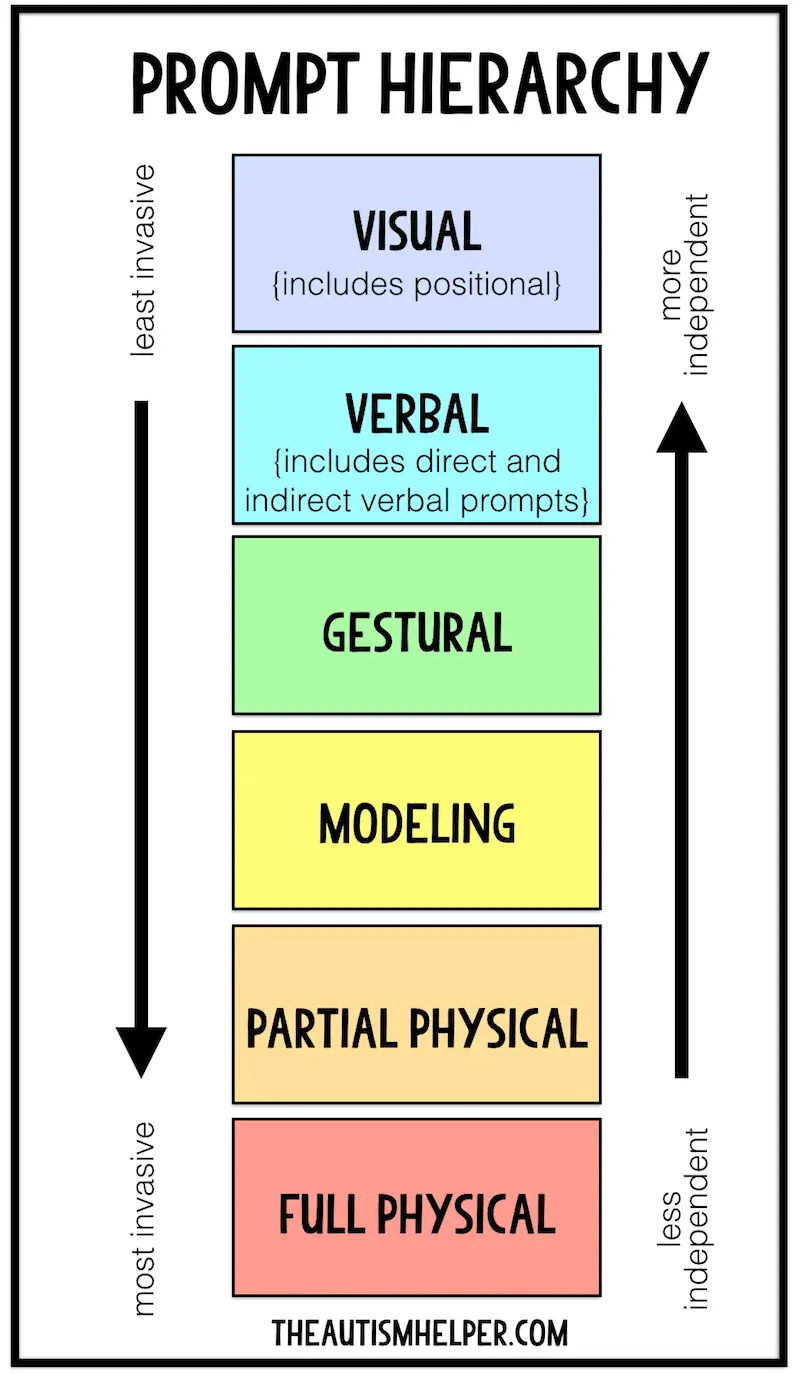
There are different types of prompts that fall into a hierarchy or order. Understanding this order will also help to eventually fade these prompts as a skill is learned and mastered. At the bottom of the hierarchy are the most intrusive and least amount of independence prompts. As we move up the list, the prompts become less invasive and the person’s independence increases.
What is the prompt hierarchy or order?
Let’s have a look at the prompt hierarchy moving from the most invasive/less independent to the least invasive/most independent.
- Physical Prompt (Full or partial) – This involves full physical assistance such as hand over hand to perform a task or partial assistance such as a touch on the wrist or elbow to remind a person of the action required. Be aware that some individuals find physical prompts too overwhelming or intrusive and this form of prompting may not be suitable in some settings. These prompts should be faded as the skill is learned.
- Modeling – This involves showing the person the correct response. A teacher, parent or classmate demonstrates the skill. The entire action may be modeled or only a relevant portion of it.
- Gestural Prompt – Here you are giving some type of gesture or movement that shows the person what to do. Gesture prompts can include such things as pointing, looking at, motioning toward, or moving closer to the correct response.
- Verbal Prompt – This involves providing some type of verbal language to cause the correct response. A direct verbal prompt gives the exact answer ex. go to your room. An indirect verbal prompt gives a hint without giving the full response. These are typically used for instruction after the individual has shown some skill acquisition on a task but is not performing independently.
- Visual Prompt – This includes some type of visual cue to the person about how to respond (in addition to natural cues) such as pictures, text, photos, or videos. Some individuals with a visual learning preference will continue to find visual prompts useful. These prompts might not need to be faded.
You can also utilize prompting through least to most on this hierarchy list. In this procedure, you start with the least invasive prompts and move down the list until the person can accomplish the task. Always determine a person’s preferences and take note of reactions to different prompting procedures. For example, my daughter doesn’t like to be touched so hand over hand is upsetting for her.
How do I use prompts?
- Figure out when prompting is needed. This is likely to be when a person is struggling to learn a new skill. Keep in mind that the person should be able to do the skill that is being prompted. The skill should be one that they are able to do, but that needs a reminder or help.
- Determine which type of prompt is needed. Start with the least invasive. If that is not enough information, a more obvious prompt may be needed such as a gesture or modeling.
- Use the prompt when the person is expected to use a behavior or skill.
- Fade the prompt. Once the person has begun to use the skill when prompted, begin to fade the prompt. Fading the prompt can mean using a lower level of prompt or putting a gap between the instruction and the prompt.
How can I reduce prompt dependency?
We have to think about fading prompts from the moment that we begin instruction of any new skill. The least to most prompting strategy is a natural way to gradually fade the support person or teacher’s assistance. The person is provided an opportunity during every trial to perform the skill with the least amount of assistance prior to moving to a more intrusive level of prompting.
Here are a few tips to reduce prompt dependency from the Autism Helper’s Sasha Long:
- Make a plan for fading. Our job isn’t over once the skill has been mastered. We have to plan on getting rid of those prompts and getting the person independent. Think about how to fade prompts as soon as you start teaching the skill.
- Use least to most hierarchy of prompts when needed. Start with the least intrusive prompts as these are the easiest to fade. Move down the hierarchy list until the person can engage with the activity. If we start with less intrusive prompts, we are already closer to not needing them.
- Time Delay – Allowing for a 3 – 4 second delay for responding can make the difference between prompt dependent and independence. Many autistic individuals need additional processing time in order to respond.
- Use visual supports. Visuals are a prompt that promote independence and don’t require the teacher or support person to intervene. For example, I have a day planner on my desk with the schedule written in every day. My autistic son reads the day planner every morning so that he knows exactly what time to get ready and what items he needs for each activity. He is completely independent.
As my friend Judy Endow says – for every prompt-dependent student there has been a prompt-dependent teacher.
The purpose of using prompts is to assist individuals in making the correct response. The level of prompt that a person receives is dependent on their skill acquisition level. It is important to remember to fade the prompts as the person becomes more independent. The more someone can do things for themselves, the better they feel. Independence leads to greater control over one’s own life and decision making.
References
Inge, K., Hendricks, D. Palko, S. Using Prompts to Promote Skill Acquisition. VCU Autism Center
Long, S. How to Reduce Prompt Dependence. The Autism Helper
Long, S. How to Use Prompts Effectively and Efficiently. The Autism Helper
(January 25, 2022). Prompting. Queensland Government – Autism Hub
Editorial Policy: Autism Awareness Centre believes that education is the key to success in assisting individuals who have autism and related disorders. Autism Awareness Centre’s mission is to ensure our extensive autism resource selection features the newest titles available in North America. Note that the information contained on this web site should not be used as a substitute for medical care and advice.